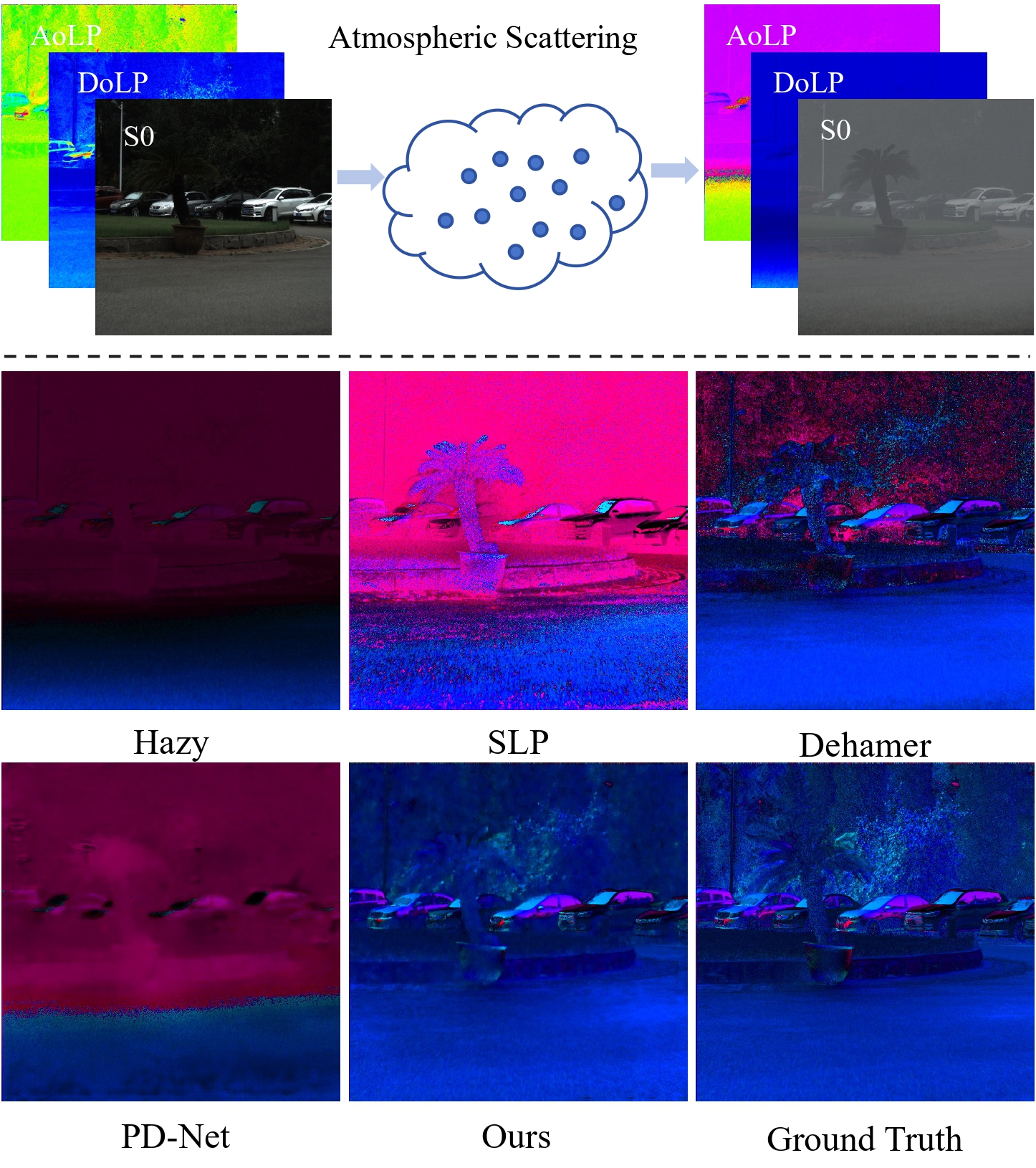
Polarization information is valuable for many computer vision applications. However, in hazy environments, polarization information is severely attenuated due to the degradation of captured polarized images. Existing dehazing methods struggle to effectively restore polarization information, as single-image methods are unaware of polarization, and polarization-based methods are constrained by the traditional polarization models. These deficiencies lead to inaccurate polarimetric signatures and physical inconsistencies in scattering environments.
To overcome these limitations and achieve the joint restoration of scene radiance and polarization information, we propose DuRP, a dual-stage physics-embedded learning framework. Specifically, we derive generalized polarization physics models that relax the ideal assumptions of traditional theory to provide a more precise foundation for the joint restoration of polarimetric and amplitude information. We then design a dual-stage neural network to estimate latent physical parameters through differentiable operators, ensuring that both the polarimetric state and radiance are accurately recovered. Experimental results show that DuRP achieves state-of-the-art performance in joint restoration and significantly enhances polarization-based vision tasks.
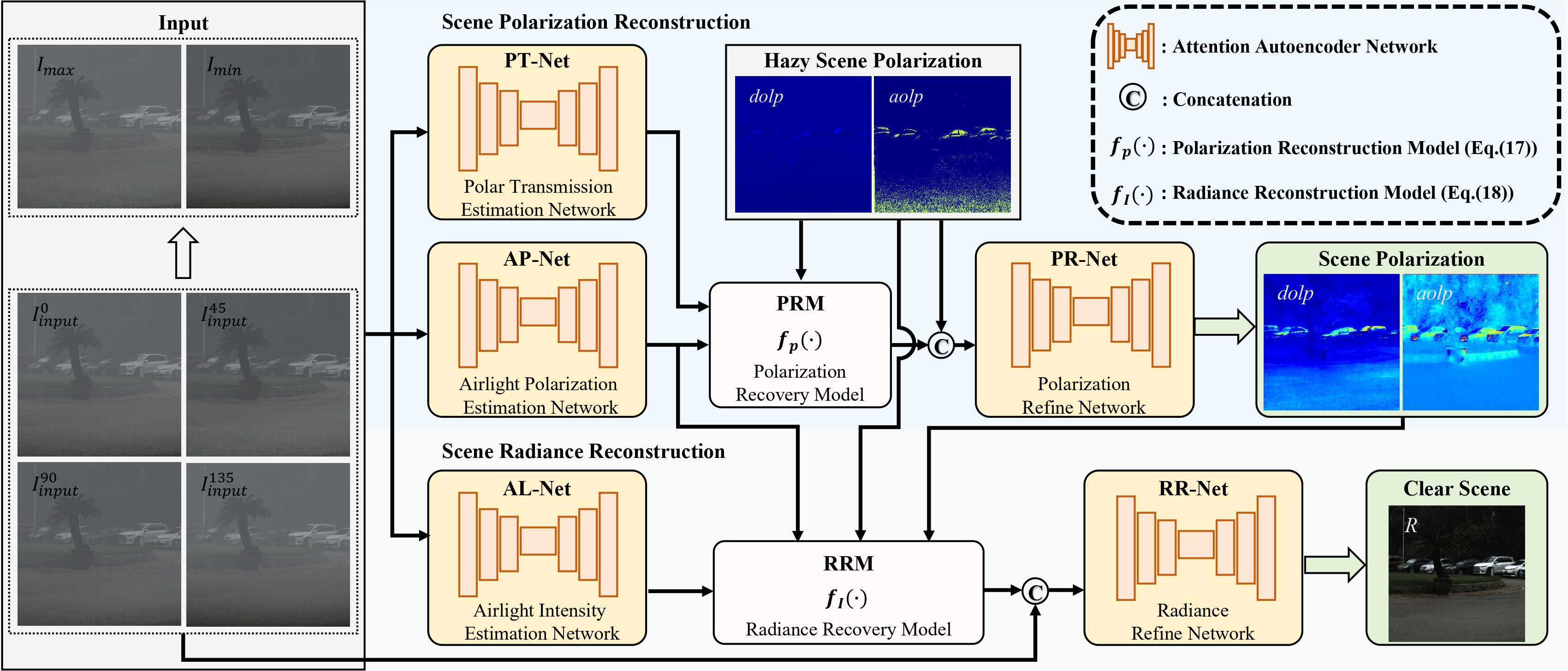
The pipeline of DuRP. We propose a dual-stage neural network that estimates latent physical parameters through differentiable operators, derived from generalized polarization physics models that relax ideal assumptions of traditional theory.
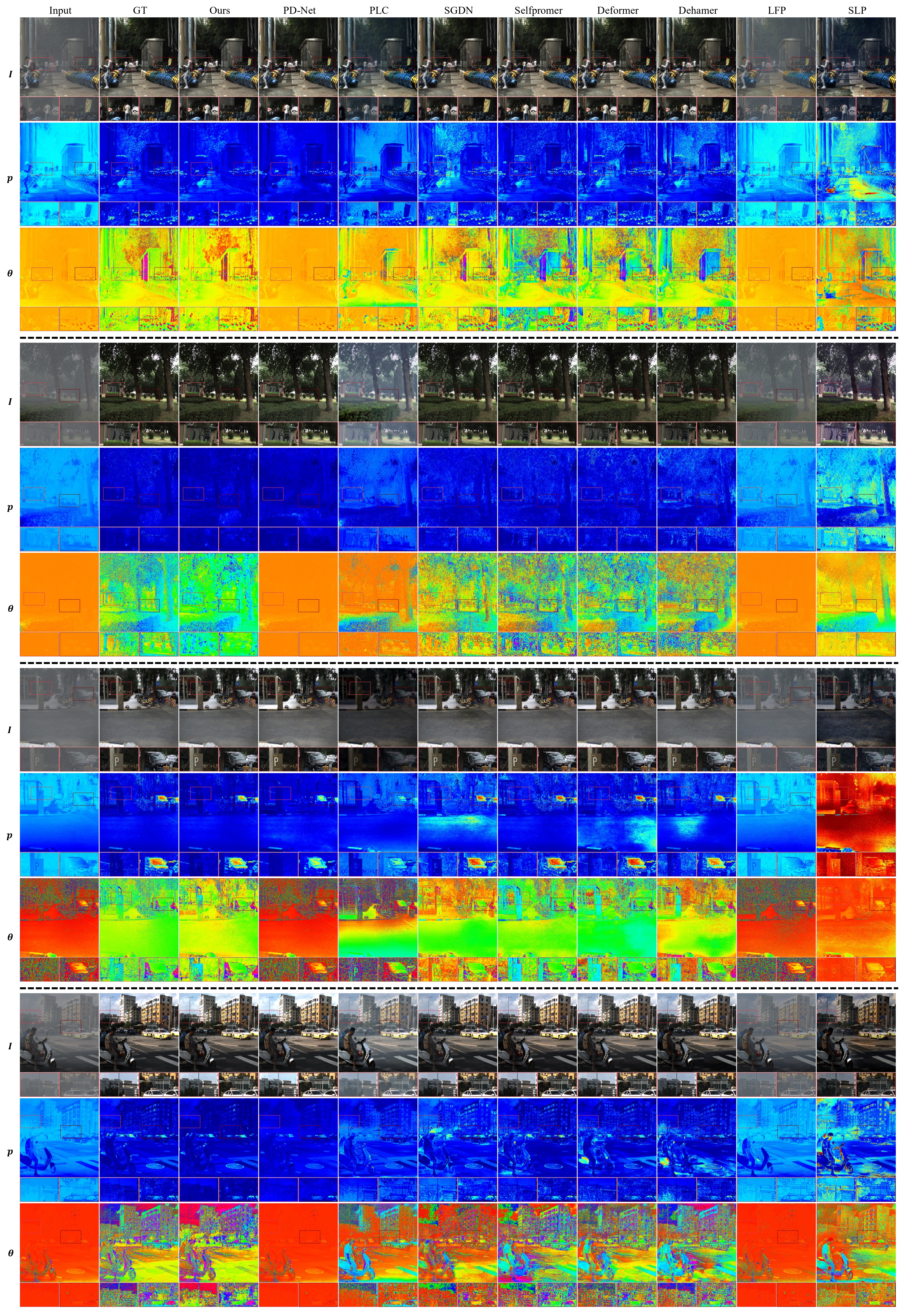
DuRP achieves state-of-the-art performance in joint restoration and significantly enhances polarization-based downstream vision tasks.
@inproceedings{yang2026durp,
  title={DuRP: Dual-Stage Physics-Embedded Learning for Joint Radiance and Polarization Restoration},
  author={Yang, Zhenshuo and He, Qian and Liu, Zhiyuan and Fan, Baojie and Tian, Jiandong},
  booktitle={Proceedings of the 43rd International Conference on Machine Learning},
  year={2026}
}